
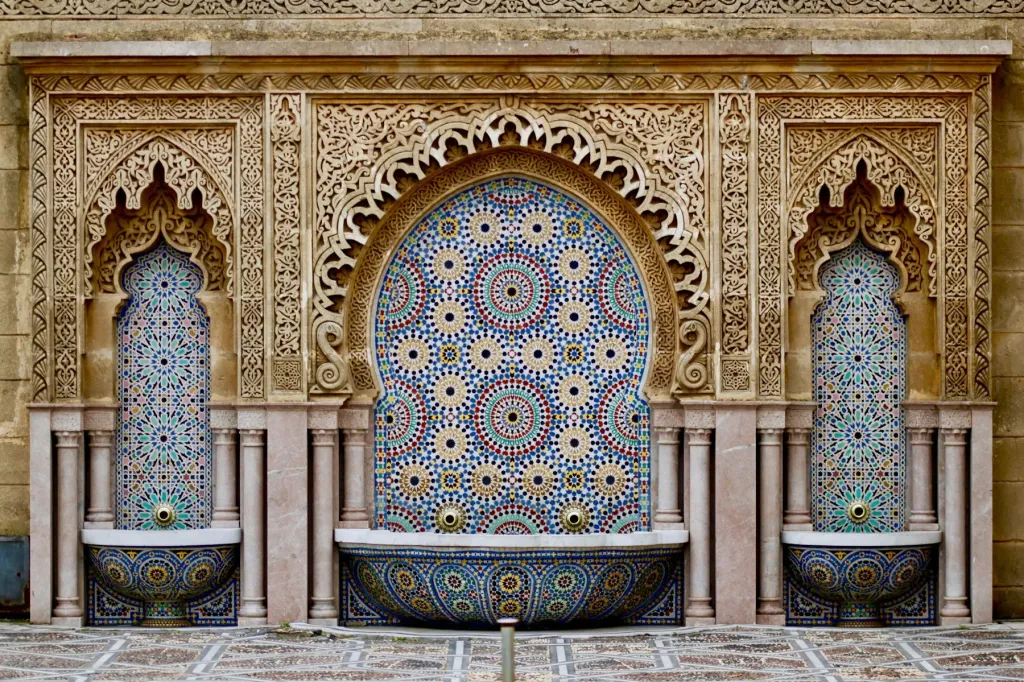
The door was so plain I walked past it twice. A narrow lane in the Marrakech medina, a donkey cart squeezing by, a cat asleep on a step, and a heavy wooden door with a brass hand-shaped knocker. Our porter knocked, the door swung open, and the noise of the city simply stopped. Inside was a courtyard tiled in green and white, a fountain trickling into a stone basin, and an orange tree heavy with fruit. Someone handed me a glass of mint tea before I had even put my bag down.
That is the magic of a riad: a traditional house built around an inner courtyard, turned inward against the heat, the dust and the crowds. Most of them are now small guesthouses, and staying in one is, for me, the single best reason to visit Marrakech.
Over two trips, my friend Tess and I have stayed in five riads inside the old city, from an eight-room hideaway to a grand restored palace. These are my notes on how to choose one, what you get for your money, and why the rooftop breakfast deserves a section of its own.
In this story8 sections
Riad, dar or hotel: what you are actually booking
Strictly speaking, a riad has a central garden courtyard, usually with planted trees, while a dar has a simpler courtyard without a garden. In practice, almost every small medina guesthouse calls itself a riad. What matters more is size: most have somewhere between 4 and 12 rooms, set around the courtyard on two or three floors, with a rooftop terrace on top.
That intimacy is the whole point. The staff learn your name on day one, breakfast is cooked for a handful of guests, and you often get the courtyard pool, if there is one, to yourself. The trade-offs are thin walls, steep stairs and rooms that face inward, so windows look onto the courtyard rather than the street.
Where in the medina to stay
The medina is a walled maze of roughly two square miles, and location makes a bigger difference than most people expect. The first time we stayed deep in the northern souks, and every trip home at night became a slightly anxious puzzle. Now I look for riads within about a 10-minute walk of Jemaa el-Fnaa, the great central square, and close to a lane a taxi can reach.
- Mouassine is my favorite neighborhood: artsy, close to the souks and the lovely Le Jardin Secret gardens, and a little calmer than the area right by the square.
- Riad Zitoun, the lanes south and east of the square, puts you near the Bahia Palace and the Mellah, the old Jewish quarter, with easy walking to everything.
- The Kasbah, in the south, is quieter and more residential, near the Saadian Tombs and with easy taxi access, though a longer walk to the souks.
Before you go
- Ask your riad to arrange airport pickup, usually about $15 to $25. Cars cannot reach most riad doors, so a porter will meet you with a cart and walk you in.
- Save the riad’s location offline and take a photo of the door. Many lanes look identical after dark.
- US citizens do not need a visa for stays in Morocco of up to 90 days.
Five riads, from intimate to grand
The intimate ones
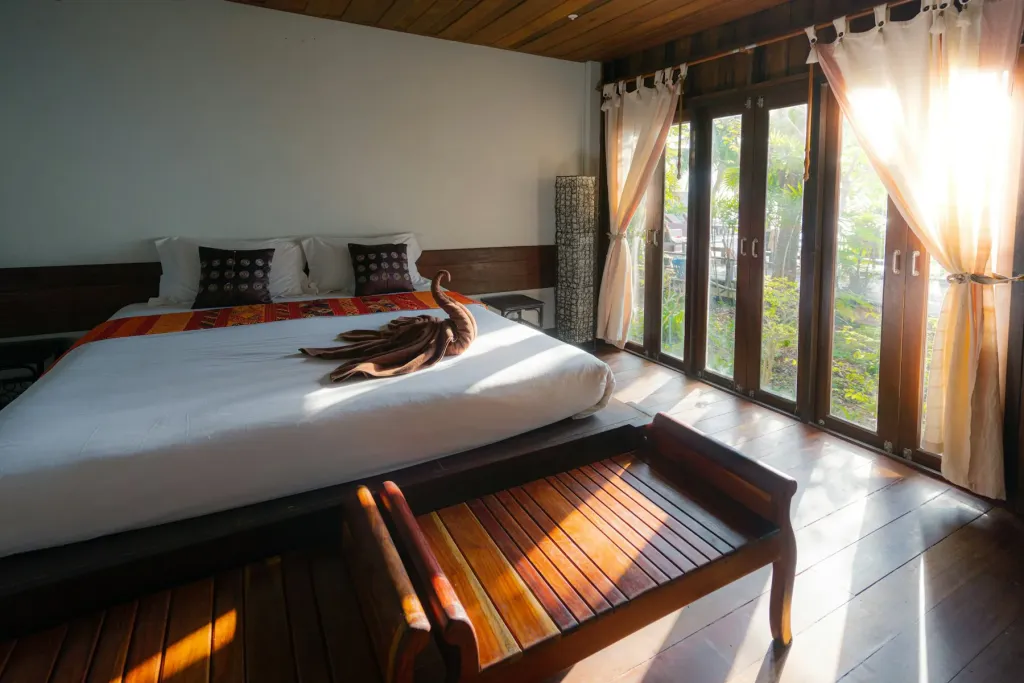
Our favorite stay was an eight-room riad in Mouassine, run by a French-Moroccan couple, for about $180 a night. The rooms had tadelakt walls, the polished lime plaster that glows like soft stone, and handwoven blankets on the beds. Every afternoon, the house cook baked msemen, the flaky square pancakes, for anyone who happened to wander into the courtyard. It felt less like a hotel and more like staying with a very stylish aunt.
A second small riad, near Riad Zitoun, cost only $110 and had a tiny plunge pool in the courtyard. It was simpler, the shower ran warm rather than hot, but the welcome was just as kind.
The grand ones
For our last two nights, we splurged on a restored 19th-century palace riad near the Kasbah, about $450 a night. Three courtyards, carved cedar ceilings, a proper hammam and a heated pool surrounded by orange trees. It was breathtaking, and the service was flawless, but with nearly 20 rooms it felt more like a boutique hotel than a home. Wonderful for a special occasion; less personal than the small ones.
The other two riads fell somewhere between. One had a tired room that did not match its photos, which taught me to read recent reviews carefully and to look for guest photos rather than only professional ones.

The rooftop breakfast deserves its own section
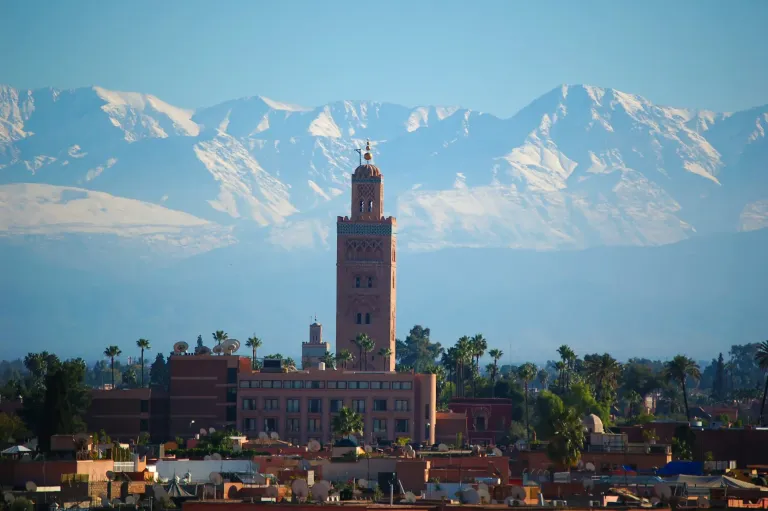
Every riad we stayed in served breakfast on the roof, and every one of them was a highlight. Go up around 8 a.m., before the sun gets strong. The city is still waking up below you: doves on the walls, a street sweeper’s broom, the call to prayer floating over the rooftops, and on clear mornings in winter and spring, the snowy Atlas Mountains on the horizon behind the Koutoubia minaret.
Then the food arrives, usually in waves. Fresh-squeezed orange juice. Mint tea poured from a height. Baghrir, the spongy semolina pancakes with a thousand little holes, with honey and butter. Msemen, olives, fresh goat cheese, boiled eggs with cumin and salt. And amlou, a spread of almonds, honey and argan oil that I would gladly eat with a spoon.
Every morning began the same way: orange juice, mint tea and the call to prayer drifting over the rooftops.
Maya Collins

Riads I would book again
Where I’d stay again
 StayOur pick
An eight-room riad in Mouassine
Mouassine, Marrakech
- Rooftop breakfast
- Ten minutes to Jemaa el-Fnaa
- Airport pickup on request
from$180/ night
Check availability — An eight-room riad in Mouassine StaySplurge
A restored palace riad near the Kasbah
Kasbah, Marrakech
- Heated courtyard pool
- Private hammam
- Atlas views from the roof
from$450/ night
Check availability — A restored palace riad near the Kasbah StayBest value
A plunge-pool riad off Riad Zitoun
Riad Zitoun, Marrakech
- Courtyard plunge pool
- Home-cooked dinners
- Walk to Bahia Palace
from$110/ night
Check availability — A plunge-pool riad off Riad ZitounSome links are affiliate links: we may earn a small commission at no extra cost to you.
Practical notes for your trip
There are nonstop flights from New York to Casablanca on Morocco’s national carrier, with an easy connection to Marrakech; otherwise most US travelers fly via a European hub like Paris, Madrid or London. The local currency is the Moroccan dirham, which you cannot buy outside the country, so use an ATM at the airport. Riads usually accept cards, but many prefer cash, and some add a small surcharge for card payments.
The best months are March to May and October to November, with warm days and cool nights. Summer often climbs past 100°F, and winter nights can be cold in riads without heating, so ask before you book in December or January. If your trip falls during Ramadan, many riads still serve breakfast to guests, but the city’s rhythm changes, especially around sunset.
Good to know
Most riad prices include breakfast, but dinner is usually extra and must be booked by midday. Book at least one; a slow tagine dinner in the courtyard by candlelight is one of the nicest evenings you can have in Morocco.
Destination guide · Morocco
Marrakech
Souks, riads and Atlas Mountain day trips
- Best time to visit
- March to May, October to November
- Daily budget
- Budget-friendly
- Visa for US citizens
- Visa-free up to 90 days
- Language
- Arabic, Berber, French
- Currency
- Moroccan dirham (MAD)
- Time zone
- Africa/Casablanca
Marrakech can be loud, tiring and wonderfully overwhelming. That is exactly why the riad matters. Every evening, when the door closed behind us and the fountain started trickling again, the whole city seemed to take a deep breath along with us. Then the next morning, we climbed the stairs to the roof and did it all over again.