

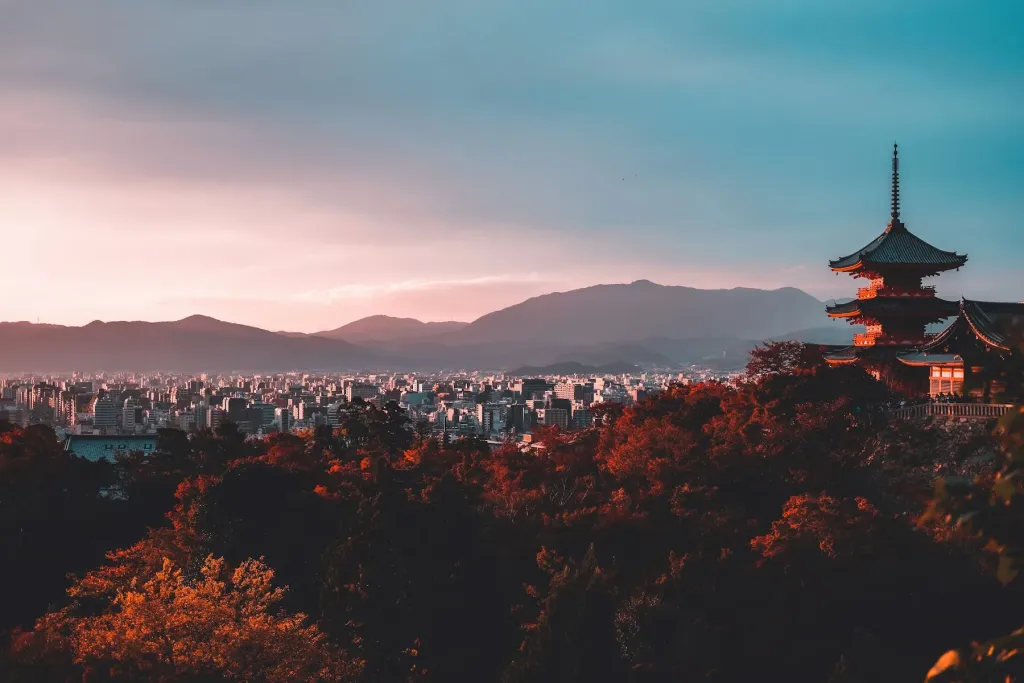
Kyoto had fed us beautifully for five days: lacquered trays of tofu, tiny perfect bowls of pickles, matcha whisked in silence. By the sixth day, my two friends and I were craving something louder. So we took the train 30 minutes south to Osaka, a city that cheerfully calls itself tenka no daidokoro, “the nation’s kitchen,” and has a local motto, kuidaore, that roughly translates to “eat until you drop.”
We gave ourselves one afternoon and one night. The plan was simple: start at a market, end with ramen, and eat every classic Osaka street food in between. It turned out to be the most fun night of our entire Japan trip, and also the cheapest.
Here is exactly how we did it, what to order at each stop, and the small etiquette rules that will keep you from being the tourist who double-dips.
In this story8 sections
Getting down from Kyoto
Osaka is an easy half-day from Kyoto, which is why it fits so neatly into an autumn Japan trip. The fastest simple option is the JR Special Rapid from Kyoto Station to Osaka Station, about 30 minutes and roughly $4 each way. If you are staying near Gion or Kawaramachi, the private Keihan and Hankyu lines are just as easy and cheaper. Load an IC card like ICOCA (or Suica in your phone’s wallet) and tap through all of them.
We arrived around 1 p.m., dropped nothing at a hotel (we were heading back to Kyoto on the last train), and went straight to the subway for Nippombashi.
1:30 p.m. Kuromon Market
Kuromon Ichiba is a covered market of about 150 stalls, nicknamed “Osaka’s kitchen.” It has become very tourist-focused in recent years and prices reflect that, but it is still a great way to start, provided you arrive early. Many stalls wind down in the mid-to-late afternoon.
We shared rather than committed to anything big:
- Grilled scallop in the shell with butter and soy, blowtorched in front of us. About $6–8.
- Tamagoyaki, a sweet-savory rolled omelet sold on a stick, about $2.
- Fresh strawberries skewered on a stick, which sound boring and are not.
Skip the giant crab legs and wagyu skewers unless you really want them; they’re priced for visitors. And note that eating while walking is frowned on here. Most stalls have a little standing area. Eat there, toss your trash in their bin, and move on.
4 p.m. Takoyaki and a breather
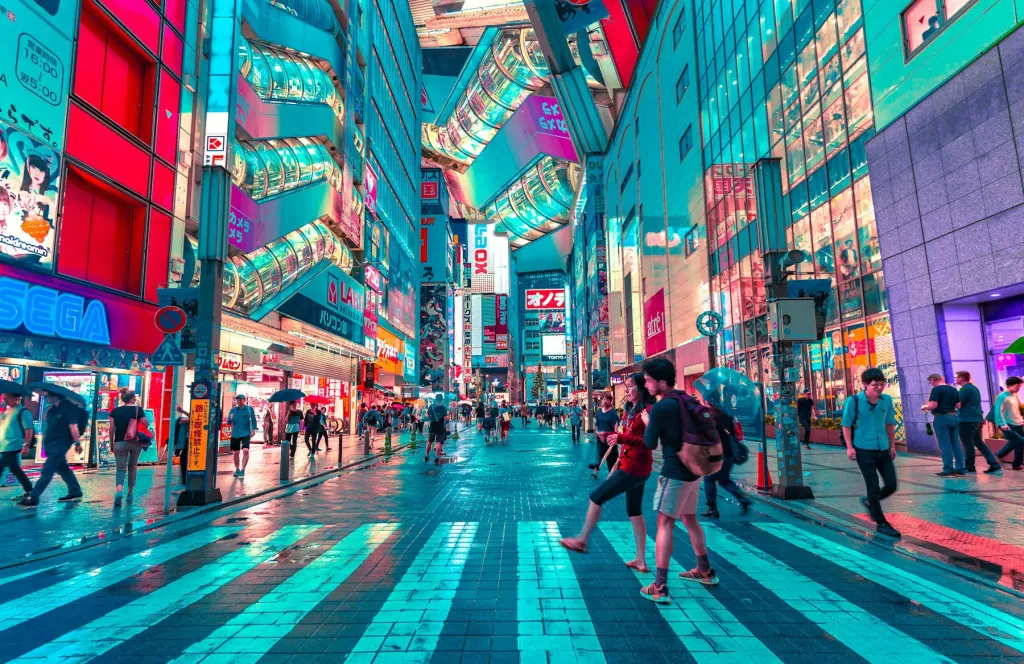
From Kuromon it is a ten-minute walk to the Dotonbori canal, and the first thing you must eat there is takoyaki: golf ball–sized dumplings of wheat batter with a chunk of octopus inside, cooked in cast-iron molds and flipped with picks at astonishing speed. They’re topped with a brown sweet-savory sauce, mayonnaise, green seaweed powder and bonito flakes that wave in the heat like they’re alive.
Order a box of six or eight (about $4–6) and listen to me: let them cool. The outside is crisp but the inside is molten batter. One of us ignored this and spent the next twenty minutes speaking with a lisp. Break one open with your chopstick or toothpick first and wait a minute.
Then walk ten minutes south to Hozenji Yokocho, a narrow stone-paved alley lined with old restaurants and lanterns. At its small temple, people splash water on a statue completely covered in thick green moss. After the chaos of Dotonbori, it’s a calm few minutes, and you will need them.
Osaka has a word for its whole philosophy: kuidaore, eat until you drop. We took it literally.
Maya Collins
6 p.m. Okonomiyaki, the main event
If you only eat one sit-down meal in Osaka, make it okonomiyaki. The name means something like “grilled as you like,” and the Osaka style mixes cabbage, batter, egg and your choice of fillings (pork belly, squid, shrimp) into a thick pancake cooked on a griddle, then painted with sauce and mayo and showered with bonito and seaweed.
We went to a busy, old-fashioned place off the main Dotonbori strip with a teppan griddle at every table, the sort with a short line of locals outside and a menu with pictures. At some places the staff cook it for you; at others they bring a bowl of raw ingredients and you mix and flip it yourself. Either way, eat it straight off the griddle with the small metal spatula. Budget around $10–15 per person, plus a cold beer.
Ask for one modan-yaki to share, too, the same pancake with a layer of yakisoba noodles cooked inside. It is completely unnecessary and absolutely delicious.
8:30 p.m. Kushikatsu in Shinsekai
Next, we rode the subway two stops to Shinsekai, an older, slightly scruffy neighborhood beneath the Tsutenkaku tower that looks the way Osaka probably looked in the 1960s. This is the home of kushikatsu: skewers of meat, seafood and vegetables, breaded and deep-fried, then dunked in a shared tin of thin, tangy sauce.
The one unbreakable rule is printed on signs in every shop: no double-dipping. Dip each skewer once, before your first bite. If you want more sauce afterwards, use a piece of the free raw cabbage on the table as a scoop. Pros order a mix: beef, pork, shrimp, lotus root, shiitake, quail egg, asparagus, and, if you’re brave, a fried camembert. Skewers run about $1–2.50 each, and ten between three people disappear frighteningly fast.
Good to know
- Japan is much more card-friendly than it used to be, but small stalls still prefer cash. Carry about ¥10,000 (roughly $65–70) in smaller notes.
- Lines are part of the culture. A short line of locals is the best review you’ll get.
- Tipping isn’t done. Just say “gochisōsama deshita” (thank you for the meal) when you leave.
11 p.m. Ramen to end it
We said we were full. We were lying. Back in Dotonbori, a few ramen shops stay open very late, including the long-running Kinryu Ramen, easy to spot by the giant green dragon on its sign. You buy a ticket from a vending machine, take a seat on a tatami platform or at the counter, and help yourself to free kimchi, garlic and chives. The pork-bone broth is light and simple, a little salty, and exactly right at that hour. A bowl is about $6–8.
From there it was a sprint to Namba and on to Osaka Station for one of the last trains back to Kyoto, a little before midnight. Check the time of your final train before you start drinking; a taxi back is very expensive.
Planning your own night
Cost: Our whole crawl, including transport from Kyoto, came to about $60–75 per person, beer included.
Getting to Japan: Nonstop flights reach Osaka Kansai from several US West Coast cities and Tokyo from most major US hubs. US passport holders can visit Japan visa-free for up to 90 days; filling in the Visit Japan Web form before you fly speeds up arrival.
When to go: We did this in mid-November, with evenings in the 50s°F, perfect for eating outside. Spring is just as good. Summer is hot and sticky, often in the 90s°F, which makes standing over a griddle a real test of commitment.
Where to stay: If you’d rather not race the last train, spend a night near Namba so you can eat as long as Osaka lets you.

Destination guide · Japan
Kyoto
Temples, gardens and slow tea mornings
- Best time to visit
- Late March to May, October to November
- Daily budget
- Pricey
- Visa for US citizens
- Visa-free up to 90 days
- Language
- Japanese
- Currency
- Japanese yen (JPY)
- Time zone
- Asia/Tokyo
I still think about Kyoto’s quiet beauty all the time. But when I want to remember being completely, joyfully happy on that trip, I think of a sticky Osaka griddle, three friends laughing too loudly, and a bowl of ramen at 11 p.m. that none of us needed. Go hungry and go late.