
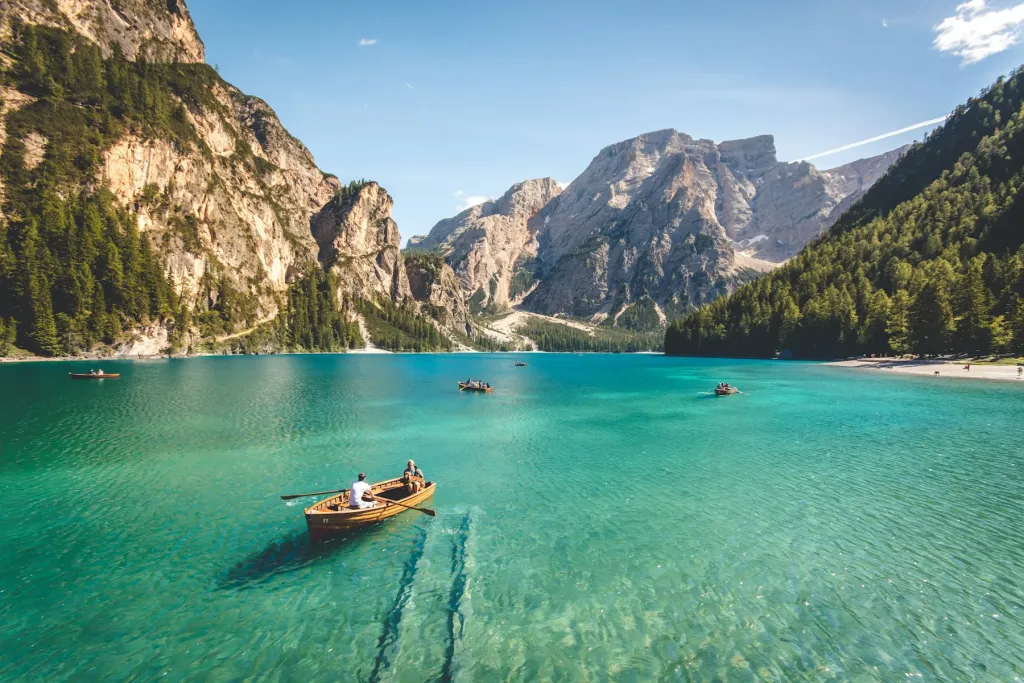
Every long trip needs a day with no plan. Ours came on day nine of two weeks in the Dolomites, after the Tre Cime loop, a 5 a.m. sunrise at Lago di Braies and one very long via ferrata that my friend Jess still refers to only as “the ladder incident.” Our legs were done. Our enthusiasm for alarms was done. What we wanted was water, shade and absolutely nothing to summit.
So we spent the day in a rented rowboat on Lago di Dobbiaco, mostly drifting, occasionally rowing, always looking up. It was, without exaggeration, one of the best days of the trip.
If you’re planning a hiking-heavy week in South Tyrol, here’s my case for building in a day like this, and exactly how we spent ours.
In this story7 sections
Why a rest day, and why this lake
The Dolomites push you to do more. Every trailhead looks better than the last, the weather windows are short, and there’s always someone at breakfast describing a hike you haven’t done yet. We’d been going hard for eight days and both of us were getting snappish in that particular way that means you need a nap and a sandwich.
We chose Lago di Dobbiaco (Toblacher See) for three reasons. It’s ten minutes from the town of Dobbiaco, where we were staying. It has rowboats you can rent without lining up for an hour. And unlike nearby Braies, it’s genuinely calm. The lake sits at about 4,100 feet in a wide green valley, ringed by spruce forest, with the pale peaks of the Sexten Dolomites rising in the distance and reed beds full of ducks along the northern shore.
It isn’t the most dramatic lake in the region. That’s exactly the point.
Morning: a slow start and a market run
We slept until 8:30, which felt rebellious. After a long breakfast at our guesthouse, the kind with five types of bread and speck sliced to order, we walked into Dobbiaco to build a picnic. The town has a couple of good supermarkets and a bakery on the main street, and we came out with more food than two people could reasonably eat:
- A wedge of local alpine cheese and a few slices of speck, the smoked ham of South Tyrol
- Schüttelbrot, the thin, crisp rye flatbread that keeps for days
- Two apples from the Val Venosta, a pot of yogurt and a bar of dark chocolate
- A bottle of sparkling water and a small bottle of Lagrein, the local red
All of it came to around $30. We packed it in a daypack with a light blanket and caught the local bus toward the lake, though it’s an easy 45-minute walk along the cycle path if you’d rather.
Our slow-day bag
Everything we carried for a full day on and around the lake.
0 of 18 packed— ready to go!
On the water: the art of doing very little
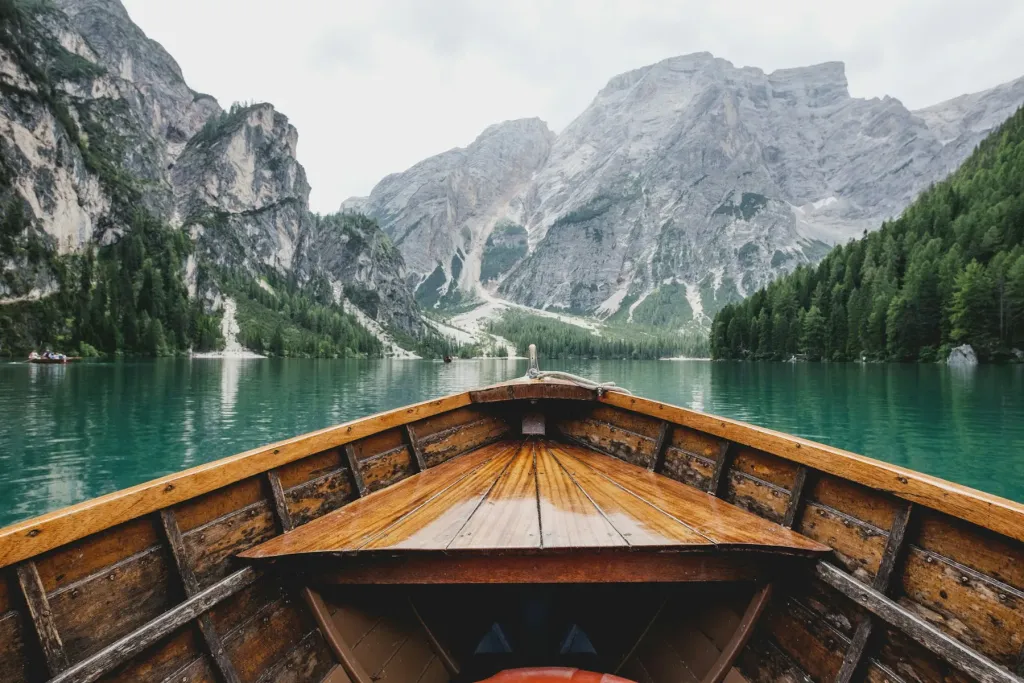
The boat rental is at the north end of the lake, next to a restaurant terrace. We paid about $20 for half an hour, then about $35 for an hour when we realized half an hour was nowhere near enough. Pedal boats are available too, but rowboats are quieter and somehow more in the spirit of things.
Neither of us is a skilled rower. For the first ten minutes we went in a slow circle while a family of mallards watched with what I can only describe as pity. Then Jess figured out that she should row and I should navigate, and we made it to the middle of the lake. There we pulled in the oars and just sat.
For the first time in nine days, nobody had to get anywhere, and the mountains didn’t seem to mind.
Maya Collins
From the center, you can see all the way up the valley toward the Höhlensteintal and the jagged peaks above it. The water is so clear near the shore that you can see the stones on the bottom, and so cold that trailing a hand in it for more than a few seconds hurts. Clouds drifted over and their shadows crossed the slopes like slow-moving animals. We talked about nothing in particular. I read two chapters of a novel. Jess fell asleep sitting up.
Afternoon: picnic, a lakeside loop and a nap
After returning the boat, we spread our blanket in a grassy spot along the western shore and ate everything. Then, because a rest day doesn’t have to be a no-walking day, we did the nature trail around the lake. It’s about 2 miles (3 km), almost entirely flat, with wooden boardwalks over the marshy southern end and small signs about the birds and wildflowers. It took us an hour at a very leisurely pace, with a long pause to watch a heron stalk fish in the reeds.
Back on the blanket, I napped for forty minutes in the shade of a spruce. When I woke up, the afternoon light had turned golden and the cyclists heading south on the long-distance Dolomites cycle path toward Cortina were starting to thin out.
Good to know
Swimming isn’t really a thing in Lago di Dobbiaco. The water stays cold all summer and there’s no designated swimming area. If you want a proper swim, the heated outdoor pools in Dobbiaco and San Candido are a much better bet, and they make a great end to a rest day.
Evening: dinner with a view
We stayed at the lake for an aperitivo on the restaurant terrace, two glasses of local white wine and a plate of Schlutzkrapfen, half-moon pasta filled with spinach and ricotta, which is the kind of thing you only need to eat once to crave forever. Around 7 p.m., the peaks behind the valley caught the last of the sun and turned faintly pink, the same alpenglow we’d set an alarm for at Braies, here for free and without a crowd.
We walked back to Dobbiaco along the cycle path as it got dark, slow and a little sunburned and happier than we’d been all week.
Planning your own slow day
Getting there: Dobbiaco is on the train line through the Pustertal, about two and a half to three hours’ drive from Venice Marco Polo Airport, which has direct summer flights from several US hubs including New York and Atlanta. Regional buses run from Dobbiaco to the lake, and the Dobbiaco to Cortina cycle path passes right by it.
When to go: Boat rentals run roughly from late May to early October, weather permitting. July and August are busiest and warmest, with highs in the mid-70s. Mid-June and September are quieter, and September brings golden larches.
Where to stay: Dobbiaco and nearby San Candido both have plenty of family-run guesthouses with generous breakfasts. Expect around $130 to $180 a night for a double in summer.
US travelers can visit Italy visa-free for up to 90 days with a valid passport. Bring some cash in euros, since small rental kiosks don’t always take cards.
The big hikes are what you’ll show people when you get home. The slow day is what you’ll remember when you’re tired at your desk on a Tuesday. Plan for both.