

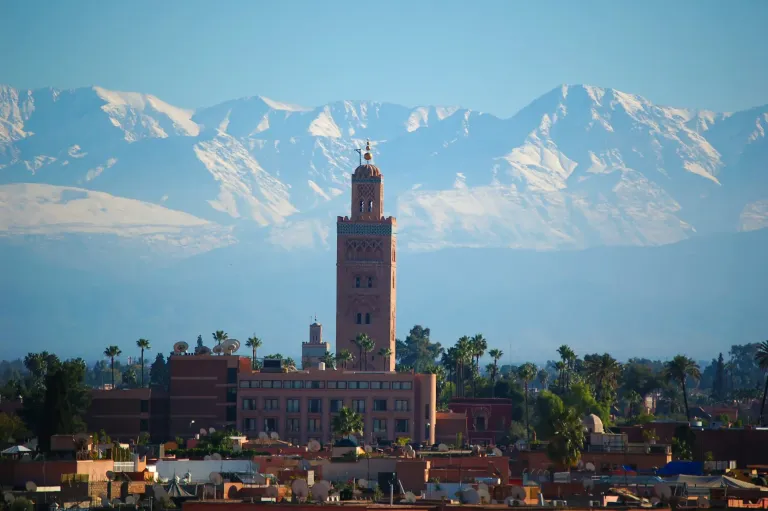
Around 5 p.m., the change starts. Handcarts roll into Jemaa el-Fnaa loaded with folded tables, gas canisters, crates of tomatoes and long steel grills. Men in white coats snap tarps into place and string up bare bulbs. By the time the call to prayer drifts over from the Koutoubia, the square has become an open-air dining room for a few thousand people, wrapped in a cloud of charcoal smoke you can see from the rooftops.
I came to Marrakech with two friends who, like me, will happily plan an entire trip around dinner. We ate in the square on four separate nights, worked our way through dozens of stalls, and came home with strong opinions and, importantly, healthy stomachs. This is everything we learned about eating well in Marrakech after dark: what to order, how the stalls work, how to deal with the hustle, and how to avoid spending day three in your riad bathroom.
One honest note up front: the stalls are numbered, and you will read online that “number such-and-such is the best.” Cooks move, quality changes, and the numbers that were great five years ago may not be now. Instead of stall numbers, I’ll teach you how to choose.
In this story7 sections
How the night market works
The food stalls fill the eastern half of the square in tidy rows, each with a counter on three sides, long benches and a cook behind a wall of displayed food. Most open around sunset and run until about midnight. Each stall specializes: grilled meats and fish, fried seafood, soups, snails, sheep’s head, or sweets and tea.
As you walk the rows, touts will step into your path with laminated menus and well-rehearsed lines in five languages. It’s part of the show, and most are good-humored. A smile, “la, shukran” (no, thank you) and continuing to walk works every time. Don’t let anyone pull you to a bench; choose it yourself.
Once you sit, bread, a small dish of olives and a tomato-and-pepper salsa often appear without being asked for. These usually cost money. That’s fine, they are cheap, but if you don’t want them, push them back politely right away.

What to eat, stall by stall
Grills: brochettes and merguez
The heart of the square. Order a mixed plate of lamb and chicken brochettes (skewers) and a few links of merguez, the spicy lamb sausage. Meat is grilled to order over charcoal, so it arrives smoky and sizzling. Tear the round khobz bread, pinch a piece of meat, swipe it through the salsa and eat with your right hand. A filling plate for one costs about $5–8.
Snail soup
Look for the carts with huge steaming pots and people slurping from small bowls. The snails are simmered in a broth heavy with thyme, anise, licorice root, orange peel and a dozen other spices, and you pick them out with a toothpick. Locals drink the broth as a digestive. A bowl costs around 50 cents to a dollar, and it is the most local thing you will eat all night.
Harira
Thick tomato, lentil and chickpea soup scented with coriander and lemon, served with dates and sometimes a sticky honey-coated pastry called chebakia. It’s cheap, filling and ideal as a first course. During Ramadan it is the traditional way to break the fast.
Sheep’s head and the adventurous end
A few stalls display steamed sheep’s heads, and the cheeks are tender and rich. If you’re curious, ask for a small portion to share. One of us loved it. Two of us were glad we tried it once.
Tea and spice cake
End at one of the stalls selling khoudenjal, a hot, peppery ginger and spice tea served in a glass, with a dense, dark slab of spice cake. It costs a couple of dollars and is the perfect finale, especially on a chilly winter night.
By the time the call to prayer drifts over the square, Jemaa el-Fnaa has become a dining room for a few thousand people.
Maya Collins
Beyond the square: tanjia and mechoui
Our best meal wasn’t technically in the square. Just off its northeast corner is a short lane often called Mechoui Alley, where a handful of counters sell lamb slow-roasted for hours in underground clay ovens. You order by weight; about a quarter kilo (half a pound) is plenty for one. It comes on paper with cumin and salt for dipping and bread on the side. The meat falls apart, the skin crackles, and you eat it standing up.
The same lane is the place to try tanjia, Marrakech’s signature dish: beef or lamb packed into a tall clay urn with preserved lemon, garlic, cumin and saffron, then left to cook overnight in the embers of a hammam furnace. The flavor is deep and sour-sweet, and nothing else tastes quite like it. Come for lunch, when the meat is freshest.
Staying healthy without being paranoid
All three of us ate street food every day for a week and none of us got sick. Luck was part of it, but these habits helped:
- Eat food cooked in front of you. Grilled skewers, boiling soups and fresh-fried fish are the safest choices.
- Follow the crowds. A stall full of Moroccan families turns its food over constantly. An empty stall with an aggressive tout does not.
- Be careful with raw salads and cut fruit that may be washed in tap water, especially on your first few days.
- Drink bottled water and check that the seal is intact. We also brushed our teeth with bottled water.
- Treat fresh orange juice wisely. The famous juice carts squeeze oranges in front of you for about $1–1.50 a glass. Ask for it without ice and watch them squeeze yours fresh, rather than pouring from a pre-filled jug.
- Carry hand sanitizer and use it before every meal, because you’ll be eating with your hands.
Good to know
Before you order, confirm the price per plate or per skewer and keep small bills and coins in dirhams. Check the bill at the end. Most stalls are honest, but “bread and olives” or an extra skewer you didn’t order can quietly appear on it. A polite question usually fixes it instantly.
Our routine for a perfect night
By the third evening we had a rhythm. We’d head up to a rooftop café terrace on the edge of the square around 6 p.m. and order mint tea while the light turned orange and the smoke started rising. (The terraces of the long-established Café de France, overlooking the square, are a classic for this.) Once the stalls were fully lit, we’d go down and graze: harira at one stall, snail soup at a cart, then a proper plate of grilled meat, then tea and spice cake. Two to three hours, about $12–15 each, and a far better night than most restaurants in the medina could offer.
Wear clothes you don’t mind smelling of charcoal. Hold your bag in front of you in the crowds. And if a musician or a henna artist approaches, know that a photo or a performance comes with an expected tip, often a few dollars.
Planning your trip
Getting there: Royal Air Maroc flies nonstop from New York JFK (and some other US cities seasonally) to Casablanca. From there it’s a short connecting flight or about a three-hour train ride to Marrakech. Many travelers also connect through European hubs straight into Marrakech Menara Airport.
Entry: US citizens can visit Morocco visa-free for up to 90 days. Your passport needs to be valid for the length of your stay, and in practice at least six months is the safe rule.
When to go: March to May and October to November are ideal, with evenings around 60–75°F. Summer nights in the square are lively but days often top 100°F. Winter evenings can drop into the 40s°F, which is when that ginger tea really earns its place.
Money: The Moroccan dirham can only be bought in Morocco. Withdraw cash from an ATM at the airport or in Gueliz; stalls only take cash. Roughly 10 dirhams equal $1.
Destination guide · Morocco
Marrakech
Souks, riads and Atlas Mountain day trips
- Best time to visit
- March to May, October to November
- Daily budget
- Budget-friendly
- Visa for US citizens
- Visa-free up to 90 days
- Language
- Arabic, Berber, French
- Currency
- Moroccan dirham (MAD)
- Time zone
- Africa/Casablanca
Some of my favorite travel memories are of sitting on a narrow bench in Jemaa el-Fnaa, elbow to elbow with strangers, smoke in my hair and lamb juice on my fingers, while drums thudded somewhere across the square. Go hungry, go curious, and go slowly. The square will feed you well.