
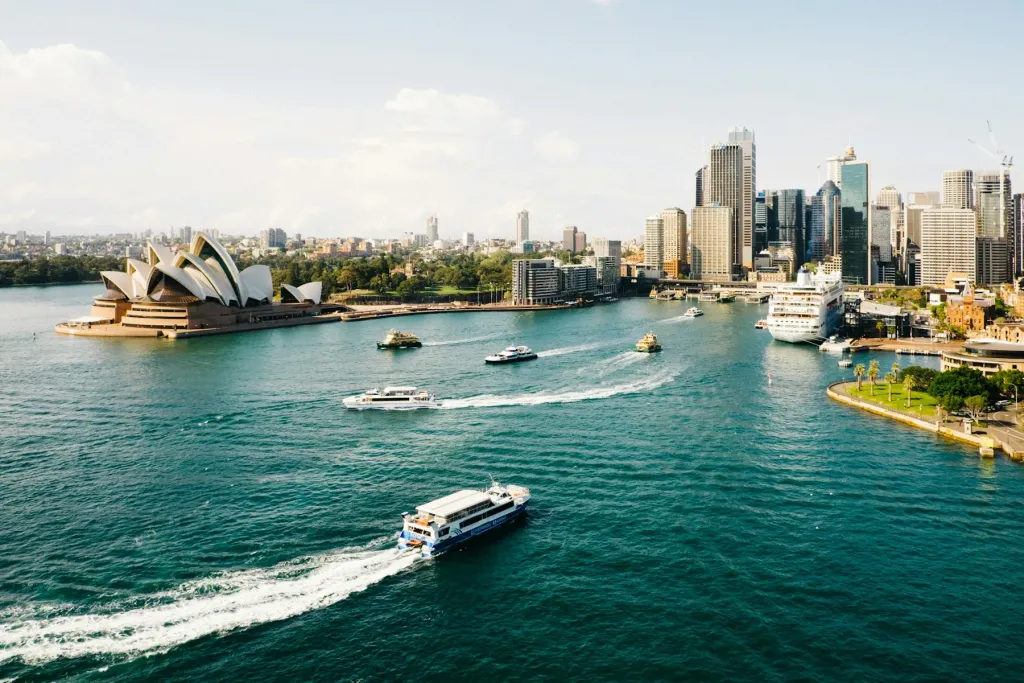
The ferry pulled out of Circular Quay at 4:30 on a Tuesday afternoon, and within two minutes the Opera House was sliding past my left shoulder while the Harbour Bridge filled the window behind me. Office workers around me scrolled their phones. I pressed my face to the glass like a kid. The fare for that ride was about $6, and it remains one of the best sightseeing tours I have ever taken.
Sydney has a reputation as one of the most expensive cities in the world, and some of that is earned. A flat white runs about $3.50, a sit-down dinner with a glass of wine can easily hit $50, and hotel rooms near the harbor will make your credit card wince. But the city’s greatest assets are its water, its beaches, its parks and its light, and nobody charges admission for those.
I spent five days in Sydney on a former teacher’s budget, and I came home feeling like I had seen the real thing. Here is how. All prices below are in US dollars, converted from Australian dollars at roughly 1.5 to 1.

In this story8 sections
Ride the ferries like a commuter
Sydney’s public ferries are the single best value in the city. You don’t need a ticket; just tap a contactless credit card or phone on the reader at the wharf, and tap off at the other end. Fares are capped daily and weekly, and on Sundays the daily cap drops to around $6 for unlimited rides on trains, buses, light rail and ferries. I planned my biggest exploring day for Sunday and rode everything.
My favorite routes:
- Circular Quay to Manly: About 30 minutes across the open harbor, past the Heads, with Opera House views both ways. Manly itself has a lovely surf beach and a calm, sheltered cove called Shelly Beach.
- Circular Quay to Watsons Bay: A quieter run to a little harbor village, where a short walk up to the Gap shows you sandstone cliffs dropping into the Pacific.
- The Parramatta River route: Less scenic in the obvious way, but a fascinating look at waterfront neighborhoods most visitors never see.
- Cockatoo Island: A former convict site and shipyard, now a UNESCO World Heritage site you can wander for free.
A six-dollar ferry gives you the same harbor as a three-hundred-dollar cruise. Sydney is full of trades like that.
Maya Collins
Walk the coast instead of paying for it
The Bondi to Coogee Coastal Walk is about 3.7 miles (6 km) of clifftop path, beaches and ocean pools, and it costs nothing. I started at Bondi around 7 a.m., when the swimmers were doing laps in the famous Icebergs pool and the morning light was soft on the sandstone. Along the way you pass Tamarama, Bronte and its ocean bath, the beautiful Waverley Cemetery perched on the cliffs and Clovelly, where I swam among small fish in the calm inlet. It took me about two and a half hours with stops.
A few other free walks I loved:
- The Royal Botanic Garden to Mrs Macquarie’s Chair, a sandstone bench carved by convicts in 1810, with a classic view of the Opera House and bridge together.
- Across the Harbour Bridge on the pedestrian walkway. The guided BridgeClimb costs more than $200; the walkway is free and the view is still remarkable.
- The Spit to Manly walk, about 6 miles through bushland and hidden beaches. Take the ferry back.

Free culture, cheap thrills
Several of Sydney’s best museums are free to enter. The Art Gallery of New South Wales has a strong collection of Aboriginal and Torres Strait Islander art and a striking new building connected by a garden path. The Museum of Contemporary Art sits right on Circular Quay, and its rooftop café has a view worth the price of a coffee. Both host free tours and talks.
The Rocks, the old neighborhood under the bridge, has a weekend market and plenty of history plaques to read for free. On weekday evenings, Darling Harbour and Barangaroo are good for a long sunset stroll, and if you happen to visit in late May or June, the Vivid Sydney festival lights up the city every night for free.
Budget tip
- Don’t buy a transit card. Tap the same contactless card or phone every time so the fare caps apply automatically.
- Refill your water bottle at public fountains; tap water in Sydney is excellent.
- Lunch specials in Chinatown, Haymarket and Newtown are some of the best value in the city.
- Supermarket picnics on the harbor beat any restaurant view.
Eating well without blowing the budget
Sydney’s food scene is driven by immigration, and that is great news for your wallet. In Haymarket and Chinatown I had steaming noodle soups for around $10, and in the inner-west neighborhood of Newtown I found Thai, Vietnamese and Lebanese spots with generous plates in the $12 to $15 range. Cabramatta, a train ride west, has some of the best Vietnamese food outside Vietnam.
Breakfast is a big deal in Australia, and the café culture is wonderful but pricey. I limited myself to one proper café brunch, a smashed avocado plate that lived up to every cliché, and made my other breakfasts in the hostel kitchen. For dinner, I often bought sushi or a cooked chicken from a supermarket and ate it on a bench by the harbor. No regrets.

Sleeping cheaply (and safely)
Accommodation is where Sydney gets you. I stayed in a well-reviewed hostel near Central Station, in a four-bed women’s dorm, for about $35 a night. It had a big kitchen, lockers, free breakfast basics and a rooftop where travelers gathered at sunset. Private rooms in the same place ran around $90.
If dorms aren’t your style, look for small hotels or apartments in neighborhoods like Surry Hills, Glebe or near train stations in North Sydney, which tend to be cheaper than the harborfront. Staying near a train line matters more than staying downtown.
What my five days actually cost
Trip budget
Five days in Sydney, solo
- Stay$17540%
- Food$16037%
- Transport$4510%
- Activities$307%
- Other$256%
Five nights in a hostel dorm. Flights from the US not included.
The “Activities” line covered a couple of small museum exhibits and a hired snorkel set. Transport includes the airport train, which is unusually expensive in Sydney at around $14 each way because of a station access fee. Some travelers save by taking a bus, but with luggage after a long flight, I paid it gladly.
Before you book
- Flights: Nonstops run from Los Angeles, San Francisco, Dallas–Fort Worth and Houston, typically 14 to 17 hours. Fares often dip in the Australian winter.
- Entry: US citizens need an Electronic Travel Authority (ETA), applied for through the official AustralianETA app before you fly. The fee is about $14.
- When to go: Spring (September to November) and autumn (March to May) bring warm days in the 70s °F and fewer crowds. Summer is hot and busy; winter is mild but too cool for most to swim.
Destination guide · Australia
Sydney
Harbor ferries, beaches and bush walks
- Best time to visit
- September to November, March to May
- Daily budget
- Pricey
- Visa for US citizens
- eVisitor/ETA required (apply online)
- Language
- English
- Currency
- Australian dollar (AUD)
- Time zone
- Australia/Sydney
On my last night, I bought a cheap bottle of water and a meat pie and sat on the steps near the Opera House as the sails turned pink. A cruise boat drifted past with people drinking champagne. I had the same view, and twenty dollars left in my pocket.